Neck Pain After a Car Accident: Causes, Signs, Next Steps
 Tyler Hamel DC, FPSC, (C)1 min read
Neck pain after a car accident often appears hours later, you may feel completely fine at the scene, answer a few questions for the other driver, file a police report, and drive home. Then you wake up the next morning and your neck feels like it has been wrung out. That pattern plays out hundreds of times a year in northeast Houston alone, and after 25 years of treating collision patients at Kingwood Chiropractic Spine and Injury Center, Dr. Tyler Hamel sees it constantly: the people who felt nothing at the scene are often the ones dealing with the most significant soft-tissue damage.
Neck injuries are the most commonly reported injury in motor vehicle collisions. Whiplash and whiplash-associated disorder (WAD) account for the large majority of cases across published collision studies, with one frequently cited dataset reporting approximately 83% of collision-related injuries presenting as WAD. The mechanics of a crash, even a low-speed one, put the cervical spine under forces it was simply not built to handle in that fraction of a second. This article explains why those injuries happen, how to recognize the symptoms that need urgent care, what to do in the first 48 hours, and what realistic recovery looks like.
Why neck pain after a car accident is so common
The physics of a rear-end collision are straightforward and unforgiving. Your car stops abruptly, but your body keeps moving forward. Your head, which weighs roughly 10 to 12 pounds and sits atop a narrow, flexible column, lags behind the rest of your body, then whips forward in the opposite direction. That rapid crack of motion stretches muscles, ligaments, and other soft tissues far beyond their normal range in milliseconds, long before any conscious bracing response is possible.
Biomechanical research confirms that low-speed collisions can generate enough force to strain cervical structures, even when vehicle damage appears minimal. The cervical spine is optimized for mobility and support under normal loads, not sudden, uncontrolled hyperextension and hyperflexion. That mismatch between what the neck is designed to handle and what a crash delivers is why soft-tissue cervical injuries are so consistent across collision types.
Why symptoms are often delayed by hours or days
During a traumatic event, the body releases adrenaline and other stress hormones that blunt pain perception. That chemical response is protective in the moment, but it can mask pain for anywhere from 12 to 72 hours after the event. Inflammation and soft-tissue swelling often peak in the first 24 to 48 hours and can continue building well beyond that window. In clinical practice, roughly one-third of motor vehicle collision patients experience delayed symptom onset of up to 48 hours, and some patients report that symptoms do not fully develop until 72 hours or later.
Feeling fine at the accident scene is not a reliable indicator of no injury. It is simply a reliable indicator of adrenaline.
How collision angle and body position change the injury pattern
Rear-end impacts produce the classic whip-crack motion, but side-impact and front-end collisions generate different stress patterns across the cervical joints. Head rotation at the moment of impact, seat position, headrest height, and whether the occupant braced against the dash or steering wheel all influence which structures absorb the most force. The injury pattern changes; the potential for soft-tissue damage does not.
What a car accident does to your neck (and why neck pain follows)
Whiplash-associated disorder is the clinical umbrella term, but the actual tissue damage underneath it varies by severity and mechanism. Understanding what was injured helps explain why two people in the same accident can present very differently.
Cervical sprain and strain: the most common injuries
A cervical strain involves the muscles and tendons of the neck; a cervical sprain involves the ligaments that stabilize the cervical joints. Both commonly occur together after a collision. Muscle strain typically presents as pain, spasm, stiffness, and worsening discomfort with movement, often extending into the trapezius or upper back. Ligament sprain may produce a sense of instability around the joint, localized tenderness near the affected vertebrae, and pain with rotation or lateral bending. In practice, clinicians document both as cervical sprain/strain because the symptoms overlap heavily unless examination or imaging points to something more specific.
Common associated symptoms include headaches that originate at the base of the skull, shoulder pain, restricted range of motion, dizziness, and occasionally tinnitus. These are all part of the whiplash spectrum and do not necessarily indicate a more severe injury on their own.
Disc injuries and facet joint damage
Disc injuries, including herniation and annular tears, are less common than soft-tissue injuries but clinically significant. A disc pressing on a cervical nerve root can cause radiating pain, numbness, or tingling that travels down the arm into the hand or fingers. Facet joints, where adjacent vertebrae connect and articulate, can sustain sharp, localized injury that produces pain specifically with rotation. Both disc injuries and facet joint damage may not appear on standard X-rays; MRI is often needed to identify them accurately.
Red flags that require same-day emergency evaluation
Most post-accident neck pain is soft-tissue in nature and responds well to conservative care. But some presentations signal something more serious, and waiting to see how they develop is the wrong move. Knowing the difference between uncomfortable-but-expected soreness and true warning signs matters.
Get emergency evaluation the same day if you experience any of the following: arm weakness, progressive numbness or tingling in the hands or fingers, loss of coordination, difficulty walking or balance problems, or any changes in bladder or bowel function. These symptoms can indicate nerve root compression from a disc herniation or, in serious cases, spinal cord involvement. They require imaging and emergency assessment, not a monitoring approach at home.
Additional symptoms that warrant prompt evaluation include severe and worsening pain rather than pain that plateaus, direct tenderness over the midline of the spine, bilateral symptoms affecting both arms or both sides of the neck, difficulty swallowing or breathing, and complete inability to rotate the head. If there was any loss of consciousness or confusion at the scene, an emergency room visit is non-negotiable, regardless of current pain level or how "minor" the crash felt.
What to do in the first 48 hours after neck pain from a car accident
The first two days after a collision set the foundation for how the neck heals. The right home care steps during this window reduce inflammation, prevent excessive stiffening, and keep tissue from guarding in patterns that become problematic weeks later.
Ice first, then heat, and keep moving gently
During the first 24 to 48 hours, apply cold packs wrapped in a cloth for 15 to 20 minutes at a time, several times a day. Cold limits acute inflammation and reduces early swelling in injured tissue. After 48 hours, switch to heat to relax muscle guarding and improve local circulation. A warm towel or low-setting heating pad applied for about 15 minutes works well. OTC pain relievers can help manage discomfort enough to allow gentle movement, for example, NSAIDs such as ibuprofen for their anti-inflammatory effect, or acetaminophen as an analgesic. That matters because prolonged bed rest allows the cervical muscles to stiffen further. Keep the neck moving within a comfortable range; gentle rotation and flexion exercises prevent the pattern of bracing and compensating that drives chronic problems.
Why professional evaluation belongs in that same window
Home care manages symptoms. It does not assess structural damage. A clinician can determine whether the injury involves soft tissue, disc, or joint structures, order imaging when indicated, and establish an accurate treatment record from the start. For anyone dealing with a PIP insurance claim or potential personal injury documentation, this timing is equally a legal and financial decision. Gaps between the accident date and the first clinical evaluation give insurers grounds to dispute injury causation, and those disputes are among the most common reasons claims face complications.
Kingwood Chiropractic Spine and Injury Center offers same-day evaluation appointments for accident patients, handles all PIP and insurance paperwork in-house, and charges nothing upfront. Starting your injury record within days of the crash is both the healthiest and the most legally sound step you can take.
How post-accident neck injuries are treated and what recovery looks like
Recovery from cervical soft-tissue injury is not linear, and the timeline depends heavily on injury severity, whether care was initiated early, and individual factors like age, prior injury history, and overall conditioning. A calibrated expectation helps prevent both over-treating mild cases and under-treating significant ones.
Evidence-based treatment for neck pain after a car accident
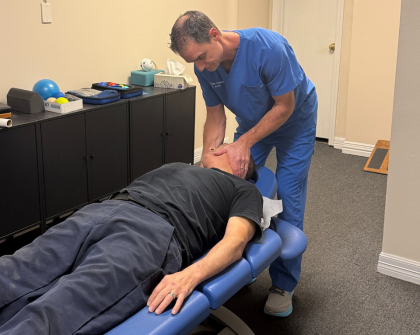
Early mobilization and neck-specific exercises form the clinical cornerstone of whiplash recovery. Clinical evidence favors early mobilization and exercise over prolonged immobilization with a soft collar. Chiropractic adjustments may be used as a complementary component to support cervical joint mobility and reduce muscle guarding, though evidence for manipulative therapy as a standalone intervention remains mixed. Cold laser therapy (photobiomodulation) and shockwave therapy are sometimes incorporated as adjunctive options, particularly in cases with persistent soft-tissue involvement, though research on these modalities is still developing and their use should be discussed individually with your provider. Medication, when used, is an adjunct to keep the patient mobile, not the primary treatment. Routine injections and surgery are not indicated for uncomplicated whiplash-associated disorders.
Realistic recovery timelines by injury severity
Mild, uncomplicated soft-tissue whiplash with early intervention typically resolves within 6 to 12 weeks. Moderate injuries involving some disc irritation, delayed care, or significant muscle guarding may take 3 to 6 months before the patient is fully functional. Patients who are not improving meaningfully by 12 weeks require reassessment for chronic whiplash-associated disorder and a more structured rehabilitation plan, often including multimodal care. Across severity levels, early active treatment is associated with better short-term pain relief and function; evidence on long-term outcome differences between very early and somewhat later care is more nuanced, but there is broad clinical agreement that prompt evaluation and movement-based care outperform a passive wait-and-see approach.
Protecting your health and your claim at the same time
Most accident victims are managing several things at once: physical pain, insurance calls, vehicle damage, and genuine confusion about what comes next. The medical and legal sides of recovery are connected, and understanding that connection prevents decisions that hurt both.
Texas requires auto insurers to offer PIP (Personal Injury Protection) coverage, though actual coverage depends on the individual's policy terms. If PIP applies, prompt medical evaluation supports a stronger claim. Chiropractic providers in Texas must submit bills to the insurer within 95 days of the treatment date under prompt-pay rules. More practically, an injury record that starts within days of the accident is far stronger than one that begins weeks later. Texas also has a high rate of uninsured drivers, making uninsured motorist claim handling an equally relevant concern for many northeast Houston residents.
At Kingwood Chiropractic Spine and Injury Center, Dr. Tyler Hamel personally evaluates every accident patient at every visit, no rotating associates, no handoffs to assistants. He provides the clinical documentation that insurers and attorneys need, coordinates directly with PIP carriers and third-party adjusters, and builds a treatment plan around the actual injury rather than a generic whiplash protocol. Same-day evaluation appointments mean the injury record starts immediately, and zero upfront cost removes the financial barrier that too often delays critical early care.
Don't wait to see how neck pain after a car accident develops
The biology of delayed onset means feeling fine at the scene is not a signal that you escaped injury. Delays in seeking care can complicate documentation for claims and may be associated with worse short-term symptoms; getting evaluated promptly gives you both a clearer clinical picture and a stronger paper trail from day one.
If you're experiencing any post-accident neck soreness, stiffness, or headaches, including symptoms that feel mild right now, the right move is to get evaluated. Start your record. Give your body a structured, clinician-guided path to recovery instead of hoping the problem resolves on its own. Call Kingwood Chiropractic Spine and Injury Center to schedule your same-day evaluation. The sooner you start, the better your outcome.